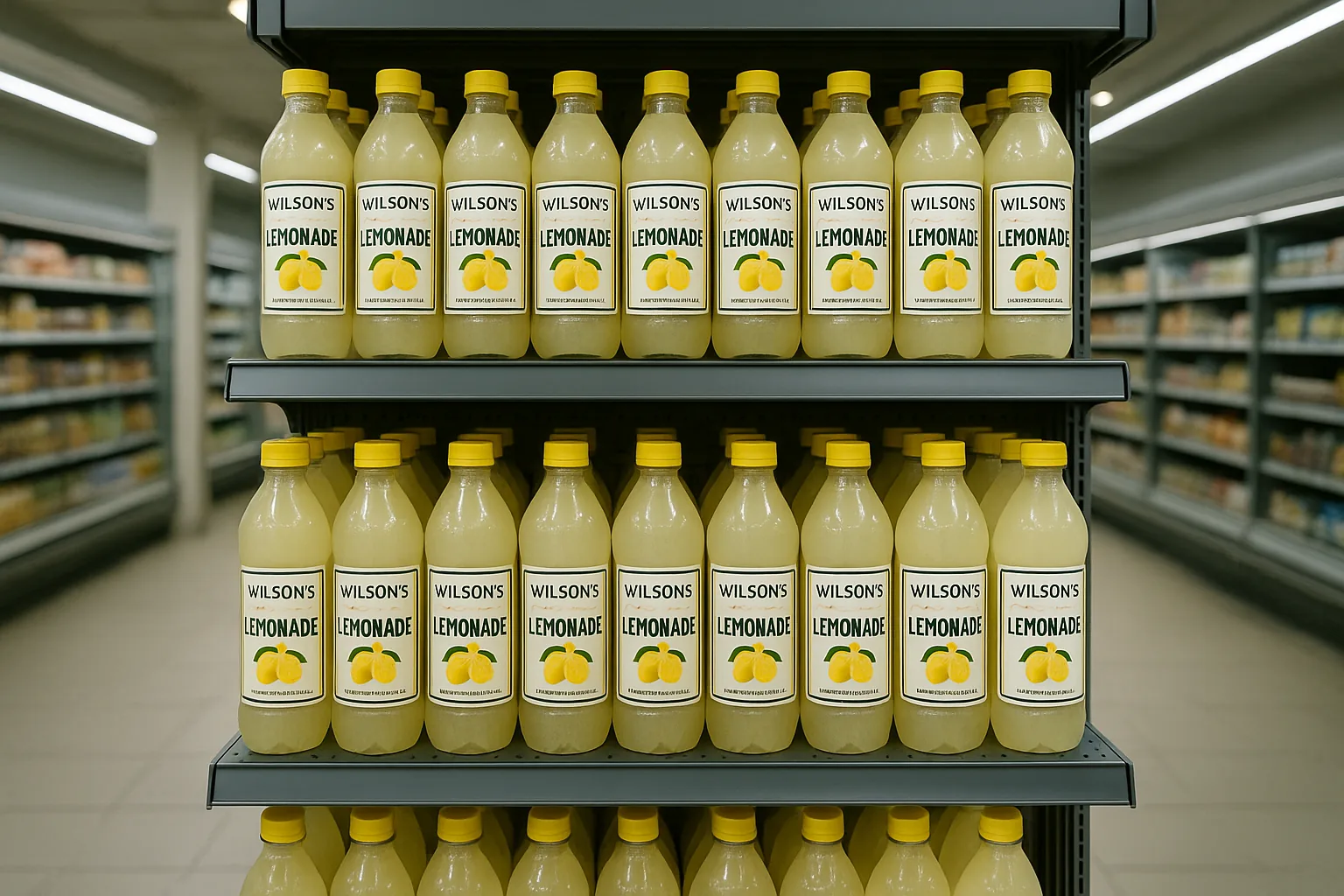
How Wilson's Lemonade reached 300+ stores and ₦30M+ in tracked retail revenue
Wilson's Lemonade scaled from a fragmented informal network to 300+ active retail stores across Lagos and Ogun State — with DALA handling shelf execution, payment collection, and weekly performance reporting.
“Working with DALA has transformed our retail business and how we distribute our products. They helped us get our products into over 300 stores across Lagos and Ogun State, drastically increasing our reach, sales and profitability.”
Kehinde, General Manager — Wilson's Juice Company
The brand before DALA
Wilson's Lemonade is a beverage brand in the drinks and fruit juice category. Before the DALA partnership, the brand was doing well enough in informal trade — selling to kiosks, small provision stores, and open market traders. The challenge was scale: the brand's team couldn't manage relationships across hundreds of stores without more people, and they didn't have the infrastructure to collect data from the field.
Modern trade — the supermarkets, convenience chains, and organised grocery stores where consumers spend more and where brand equity compounds — was out of reach. Supermarket buyers require consistency. They need reliable restocking, documentation, and proof that a brand won't let their shelves go empty mid-week. Wilson's couldn't guarantee that on their own.
The core problem: distribution without infrastructure
The General Manager's team was spending more time chasing down deliveries, resolving disputes with stores, and managing informal payment arrangements than they were on the things that actually grow a brand. Store visits happened when someone had time. Expiry management on the shelf was whoever happened to notice it. Payment from stores arrived when it arrived.
This is a common bottleneck for Nigerian FMCG brands: the product is good, the consumer demand is real, but the operational machinery to capture that demand at scale doesn't exist inside the brand. You can't outgrow a distribution problem by working harder within it.
What DALA built for Wilson's
DALA onboarded Wilson's into a structured distribution model. This started with intake into DALA's warehouse system at Iju-Ota, where stock is catalogued, barcode-verified, and entered into rotation tracking. From there, DALA's field team executed store onboarding — not just dropping stock off, but building relationships with category managers, securing proper shelf placement, and photographing every location.
The field team visits each store on a regular cadence: rotating stock using FIFO principles, checking for approaching expiry dates, confirming price tag accuracy, and documenting any restocking needs. Every visit generates a data point. Those data points become the weekly report that Wilson's General Manager receives — store by store, SKU by SKU, with sell-through rate and stock position for every active location.
Payment collection shifted from 'whenever the store gets around to it' to a structured 30-day cycle managed by DALA's operations team. The brand no longer needs to have anyone chasing payments.
The outcome: 300+ stores, ₦30M+ in tracked revenue
Within the partnership period, Wilson's Lemonade reached 300+ active retail stores across Lagos and Ogun State — a store count the brand could not have managed with its internal team at any sustainable level of execution quality. DALA tracked over ₦30M in retail revenue generated across those locations.
The scale change wasn't just in store numbers. The General Manager describes it as a change in the operating model: the brand now has visibility into what's selling where, which stores are highest velocity, and where to prioritise the next expansion push. That intelligence didn't exist before — every distribution decision was a guess.
The DALA operating layer
What this case study proves
Store penetration
Which stores carry the product, where coverage is still missing, and what the next placement wave should target.
Field execution
Visit notes, shelf photos, facing checks, FIFO rotation, stockout flags, and issue escalation.
Commercial visibility
Tracked revenue, SKU movement, account performance, and payment status in one operating view.
Retail discipline
Documentation and standards that reduce payment disputes, buyer friction, and silent shelf failures.
Related next steps
Your brand can build this kind of retail record too.
If your product is retail-ready, DALA can help you move from scattered store conversations to a measurable execution system.
Start your application