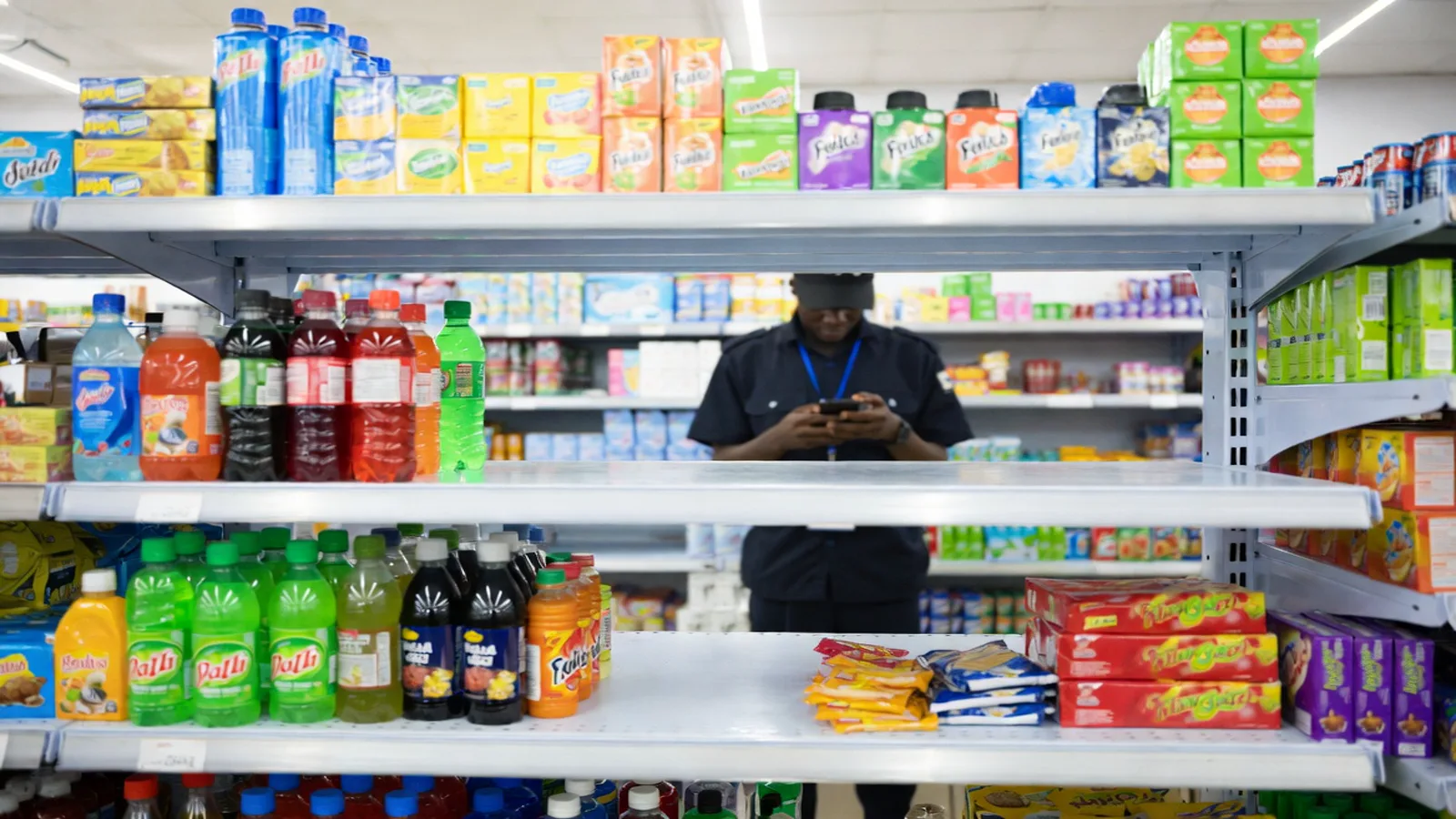
What on-shelf availability actually measures
On-shelf availability (OSA) measures the percentage of time that a product is present and purchasable at the shelf position it is supposed to occupy. A product that is listed by a supermarket but is out of stock 30% of the time has an OSA of 70%. That missing 30% represents revenue that was permanently lost, not deferred. A consumer who finds an empty shelf does not typically wait for the product to be restocked; they buy a competitor or leave without buying.
Global FMCG benchmarks put the ideal OSA at 95–98% for fast-moving categories. In developed market supermarkets with sophisticated supply chains and automated replenishment, most large brands operate at 93–97%. In Nigerian modern trade, the same brands often perform 20–30 percentage points lower, not because the products are unavailable in Nigeria but because the store-level replenishment and field management systems that maintain OSA in developed markets are absent.
Where Nigerian retail underperforms on OSA
The OSA gap in Nigerian supermarkets is driven by four structural factors. First, replenishment is manual and often reactive rather than proactive. Store staff restock shelves when they notice they are empty rather than on a schedule tied to velocity data. Second, back-of-store stock is often disorganised, so even when stock is physically present in the store, it is not making it onto shelves in time. Third, there is no systematic field verification from brand side: without regular field visits confirming shelf presence, brands do not know they have a stockout until a sale has already been lost. Fourth, payment cycle delays slow the replenishment loop: when a distributor is waiting on payment from one account, the capital to restock that account may not be available.
| Metric | Industry Average | DALA Partners |
|---|---|---|
| On-shelf availability | 62–70% | 88–94% |
| Stockout recovery time | 4.8 days avg. | 1.2 days avg. |
| Field visit frequency | Monthly or less | Weekly |
| Payment cycle to brand | 45–90 days | 30 days |
Source: DALA operational data 2025; NielsenIQ West Africa retail benchmarks
How DALA measures and maintains OSA
DALA field representatives conduct weekly store visits across the partner network. Each visit records shelf stock levels, facing count, pricing compliance, and the presence of any competitor products in allocated shelf space. This data is logged at the store level and aggregated into the brand's account dashboard, giving brand managers a near-real-time view of OSA performance across the entire account portfolio.
When a visit identifies a stock level below the reorder threshold, a replenishment delivery is initiated. The target is to restore shelf stock within 24 hours of identifying the low-stock condition. That 1.2-day average stockout recovery time reflects this field-to-dispatch loop. For context, a brand managing replenishment without a dedicated field team typically discovers stockouts through buyer complaints or a monthly account reconciliation, by which point the stockout may have persisted for days.
The revenue impact of closing the OSA gap
The revenue difference between 65% OSA and 91% OSA is not linear: it compounds across multiple stores and multiple weeks. A brand with 100 store accounts, each selling ₦500,000 per month at full availability, loses approximately ₦17.5M per month from the 35% OSA gap. At 91% availability, the loss shrinks to ₦4.5M. The difference, ₦13M per month, represents the commercial value of the OSA improvement alone, before considering secondary effects like buyer satisfaction and reorder frequency.
Brands that have moved from self-managed distribution to DALA's managed retail execution consistently report that the OSA improvement delivers a revenue uplift that significantly exceeds the cost of the distribution partnership in the first three months.


